NWC: close the demo and go back to Newcastle Web Co

Demo by Newcastle Web Co. This is a demo design and not a real business. Every design is one of one: when a business picks it, no one else gets it.

Demo, not a real business.

Lic. 000000C (demo)

Lic. 000000C (demo)

Bathroom renovations in Newcastle

Your daily retreat

The part of a bathroom that matters most is the part you never see again: the floor, the falls and the waterproofing under the tiles.

Book a site visitWhat it costs

Three kinds of bathroom job

We do bathroom renovations in Newcastle and the Lake Macquarie suburbs, in houses and in flats, and most calls start with a symptom: a tile that sounds hollow, grout that never stays clean, a brown mark on the ceiling of the room below. The cause is nearly always under the surface, so that's where our quote begins.

Most of the bathrooms we strip are one of three jobs. A main bathroom rebuilt where it is, with the toilet and shower staying put and everything else new. A bath pulled out to make room for a walk-in shower. Or an ensuite fitted into the corner of a bedroom, which is a bigger step because it changes a room and puts a wet area where there wasn't one.

Our carpenters frame, sheet and fit out the room. Plumbing, drainage and wiring go to licensed specialists, and the membrane is laid by a contractor whose licence covers waterproofing. One site lead books them in order, because a bathroom is a small room where five trades follow each other and nobody can start until the trade before has finished.

Moving the toilet or the shower is where prices jump: a waste needs a steady fall to the drain, so a new position means opening the floor. If the bathroom is only one room of a wider job, our renovations page covers the whole house, and a kitchen done at the same time shares the plumber's and the electrician's visits.
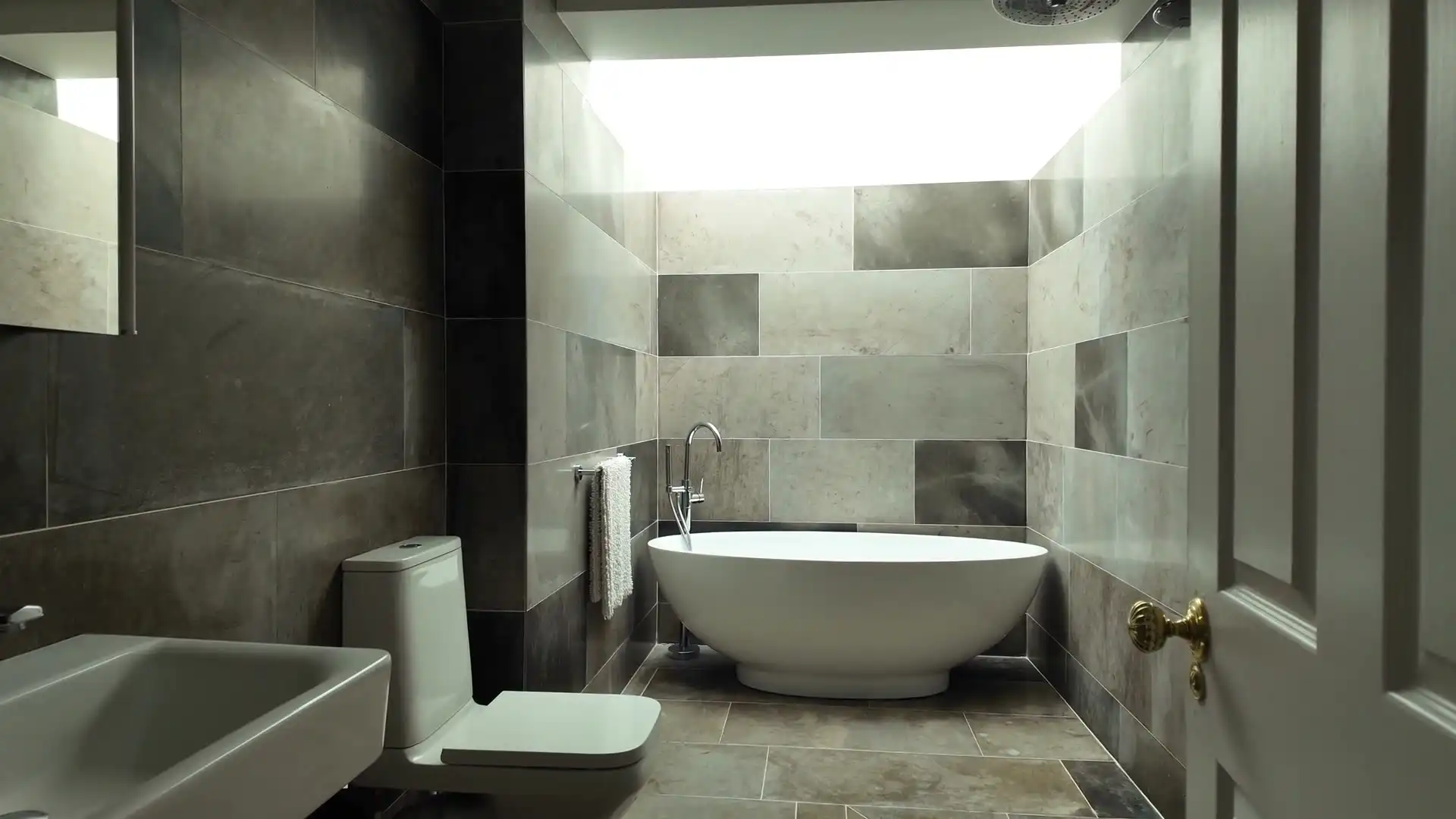
Bathroom renovations, a finished job

What sits under the tiles

Cut through a finished shower floor and you'd find six layers, each one laid on the one below it and each one relying on it. Here they are from the surface down, which is the reverse of the order we build them.

  1. Tiles and grout

    The only layer anyone sees. Tiles shed most of the water, but grout lets some through, which is why everything beneath them matters. Internal corners and the joint where wall meets floor get flexible sealant instead of grout, because those joints move.

  2. Adhesive or bedding

    Wall tiles are stuck on with adhesive; floor tiles go down on adhesive or a sand and cement bed. Either way the bed has to be full under each tile, because a hollow pocket is where a tile cracks and where water sits.

  3. The waterproofing membrane

    The layer that keeps the water in the room. The National Construction Code requires wet areas to be protected by a waterproofing system, and it refers to AS 3740 for domestic wet areas. Ours runs across the shower floor and up the walls, with bond breakers in the corners and a seal around every pipe, and it cures before anything covers it.

  4. The fall to the waste

    Beneath the membrane the floor is shaped so water runs to the waste instead of sitting. We set that fall before the membrane goes on, so the membrane follows the same slope. A floor laid dead flat and waterproofed perfectly still holds puddles, and a puddle finds the weakest joint.

  5. Substrate sheeting

    Walls are lined with sheet made for wet areas and fixed to the frame the way its maker specifies. On a timber floor the sheet or screed over the joists has to be stiff, because a substrate that flexes underfoot will crack the membrane bonded to it.

  6. Frame or slab

    A timber frame and floor in a house up on piers, a concrete slab in a house built on one and in many flats. We check timber for rot from old leaks and straighten it so the tiles sit flat. On a slab, moving a waste means cutting a channel, which is why the floor type moves the price.

Licences, waterproofing and the contract

A bathroom brings more rules than its size suggests: who may do each part of the work, what the contract has to contain, and when the room needs an approval at all.

Licences on the job

Bathroom renovations are named as general building work, so any of ours over $5,000, GST included, runs under our contractor licence. The plumbing, drainage and wiring count as specialist work, which needs its own licence at any value. Waterproofing is a separate trade category, not specialist work, and the licences that cover it include waterproofing itself, wall and floor tiling, and general building work.

Paperwork by price

From $5,000 to $20,000 it's a written small jobs contract, dated and signed by both of us, with our licence number, the work and the price. Above $20,000 it's major work: five clear business days to rescind after you get your signed copy, and our Home Building Compensation certificate before any deposit. Any deposit is capped at 10%, and you'll hold the Consumer Building Guide before signing.

Same four walls, no planning approval

Renovating a bathroom inside its existing room can count as exempt development, with no development application or certificate. It has to leave the room's configuration alone, no wall or partition taken out, carry the same loads, keep windows and doorways the same size or bigger, meet the Building Code, and the building can't be a heritage item.

Ensuites and mine subsidence

Carving an ensuite out of a bedroom changes the room, so it moves to complying development or a DA. On the subsidence side, Subsidence Advisory NSW's exempt list includes internal alterations, with ensuites and toilets among its examples, on every guideline, provided the work is steel or timber framed and nothing structural changes.

Old sheeting

A note in the state's codes flags anything built before 1990 as possibly containing asbestos, and bathroom wall and floor sheet of that age is a common place to find it. Bonded asbestos over 10 m², or friable asbestos however little there is, is taken out by a licensed removalist before our crew begins the strip.

Strata approval

In a strata flat the owners corporation has a say. Cosmetic work needs no approval and minor renovations need a general meeting resolution, but the Strata Schemes Management Act leaves waterproofing and structural change out of that minor category. Bathroom work on common property needs a special resolution or another route the by-laws allow.

What bathrooms cost

$15,000 to $45,000

Fifteen thousand rebuilds a small room with every fixture left where it is. Forty-five covers a larger room with the shower moved, the bath gone and tiles to the ceiling.

What moves it

  • Floor area, and how high the walls are tiled
  • Moving a waste, and whether the floor is timber or slab
  • Tile, tapware and fixture selections
  • Asbestos in the old sheeting

Tiles and fixtures show as allowances you can check against your selections, and the quote says up front how removal would be charged if testing finds asbestos in the old linings.

Guide ranges from published Newcastle and NSW cost guides, October 2026.

How a bathroom renovation runs

  1. Lifting a tile

    Before we price, we look for where the water has already been. We tap the tiles for hollow spots, check the ceiling or subfloor under the shower, and, with your say-so, lift a loose tile to see the bed and what's left of the old membrane. Where we can reach the pipes from below, we follow the drainage, because its route decides how freely the layout can change.

  2. Selections before demolition

    You get a drawn layout, a list of everything we need you to choose, and a fixed price on the contract that suits its size. Tiles, tapware, vanity and screen are picked and ordered before anything is pulled out, so the room never sits stripped bare while a late delivery holds up the job.

  3. Back to studs and slab

    Any sheeting that tested positive goes first, removed by a licensed removalist. Then the tiles, linings and fixtures come out until the room is down to frame and floor. Our carpenters replace rotten studs and noggings and pack the walls straight, while the plumber, drainer and electrician rough in the new positions with everything open.

  4. Falls, sheet and membrane

    The walls are lined with wet-area sheet and the floor is set to fall to the waste. The waterproofer fits bond breakers in the corners, runs the membrane across the floor and up the walls, and seals around every pipe that comes through. It cures fully and we check it before a tile goes near it, because after that nobody sees it again.

  5. Tiles, then the fit-off

    Tiling follows the falls the floor was given, with flexible sealant in the corners. The plumber connects the toilet, basin and shower, the electrician fits the lights and exhaust fan, and we hang the screen, mirror and rails. Every waste gets a run of water to prove it drains before we give the room back to you.

Bathroom renovations, another finished job

Bathroom renovations in Newcastle flats and Lake Macquarie houses

In Bar Beach much of our bathroom work is in flat blocks rather than houses, and several of those blocks are heritage items in the council's plan, Acropolis, Brooklyn Court, Kamarem Court and Parkhurst Flats among them. The exempt route for a like-for-like bathroom doesn't reach a heritage item, and neither does complying development, so where the listing covers the building, the bathroom goes to council for consent. Listings go by address, and yours is on the Spatial Viewer in the NSW Planning Portal. Inside a block, the drainage stack is often shared with the flats above and below, and every sheet of board goes up the stairs.

For bathroom renovations in Lake Macquarie, Eleebana shows why the build year matters. The estate there was announced in 1976 and released in stages through the late 1970s and early 1980s, so many of its first houses went up before 1990, the year the state's codes use as the line for possible asbestos. We have the old sheeting tested before a wall is opened. Our two area pages, Lake Macquarie and Newcastle, show how the listings and the ground change from one suburb to the next.

In a flat or a house, on timber or on a slab, the order of the layers never changes. What changes is how much has to come out, and that's what we find before we quote.

Three bathrooms, signed off

A narrow terrace, two bathrooms in a row, and a rotten floor found under the old tiles.

"Somehow a full-size shower"

"The bathroom in our terrace is barely two metres wide. They sorted the waterproofing, handed us the certificate at the end, and somehow fitted a full-size shower in."

Client
Tara
Site
Cooks Hill
Job
Bathroom
Sheet
01 of 03
Rating
5 out of 5
Status
Sample review

"Always one that worked"

"Two bathrooms done one after the other, so there was always one we could use. They told us the order on the first day and stuck to it right through."

Client
Rob
Site
Charlestown
Job
Two bathrooms
Sheet
02 of 03
Rating
5 out of 5
Status
Sample review

"Back on it next morning"

"When the old tiles came up, the floor under them was rotten. They stopped and showed us that afternoon, put the new floor in writing, and were back on the job the next morning."

Client
Ellie
Site
Kotara
Job
Bathroom
Sheet
03 of 03
Rating
5 out of 5
Status
Sample review

Sample reviews. Tallbeam is a demonstration business.

Tell us how old the bathroom is and what it's doing, and we'll come and tap the tiles, look underneath and tell you which layers need replacing.

Book a site visit(02) 5550 4806

Bathrooms: your questions

What will a bathroom renovation cost in Newcastle?

Our bathrooms run from about $15,000 to $45,000. A small room rebuilt with the toilet, shower and vanity where they are sits at the lower end. A larger room where the shower moves, the bath comes out and the walls are tiled to the ceiling sits at the upper end. Shifting drainage is the biggest single swing, then the floor area, then the tiles and fixtures you pick.

Who does the waterproofing in my bathroom, and is it licensed?

It's licensed, but not in the same way as plumbing. Waterproofing is a trade category of building work needing a contractor licence above $5,000, while the Home Building Act treats plumbing and electrical wiring as specialist work at any value. On our jobs the membrane is laid under our contract by a contractor whose licence covers waterproofing, and it cures and is checked before a single tile covers it. The details go in your records.

Can you tile over my old tiles?

We don't, in a wet area. Tiling over the top hides the membrane that's already failed or about to, and gives no chance to fix the fall to the waste or check the frame for rot. It also raises the floor, which can leave a lip at the door and change how the shower drains. The old tiles come up so the layers under them can be rebuilt properly.

What happens if you find asbestos in my bathroom?

If the house dates from before 1990 we have the old wall and floor sheet tested before anyone cuts it. Where the result is positive and there's over 10 m² of the bonded kind, or any friable material whatever the amount, a licensed removalist takes it out under SafeWork NSW rules before our crew goes further. The quote already says how that removal is priced, so a positive test changes the program, not the deal.

Can you move the toilet or the shower?

Usually, but it's the change that costs most. A toilet or shower waste needs a continuous fall to the drain, so a new position means opening the floor, and on a concrete slab that means cutting a channel. A licensed plumber and drainer lay the new pipework. On a timber floor with room underneath it's often simpler. We look at the floor and under the house before you decide, and price the move on its own.

Do I need owners corporation approval for a bathroom in a strata flat?

Usually, if any of the work is on common property. A bathroom renovation involves waterproofing, and the Strata Schemes Management Act leaves waterproofing out of the minor renovations a general meeting resolution can approve. So common property work needs a special resolution, or approval in another way the by-laws allow. Whether the floor, the membrane or the pipes are common property depends on your strata plan. We also ask who lives below, because a failed membrane shows up first on their ceiling.